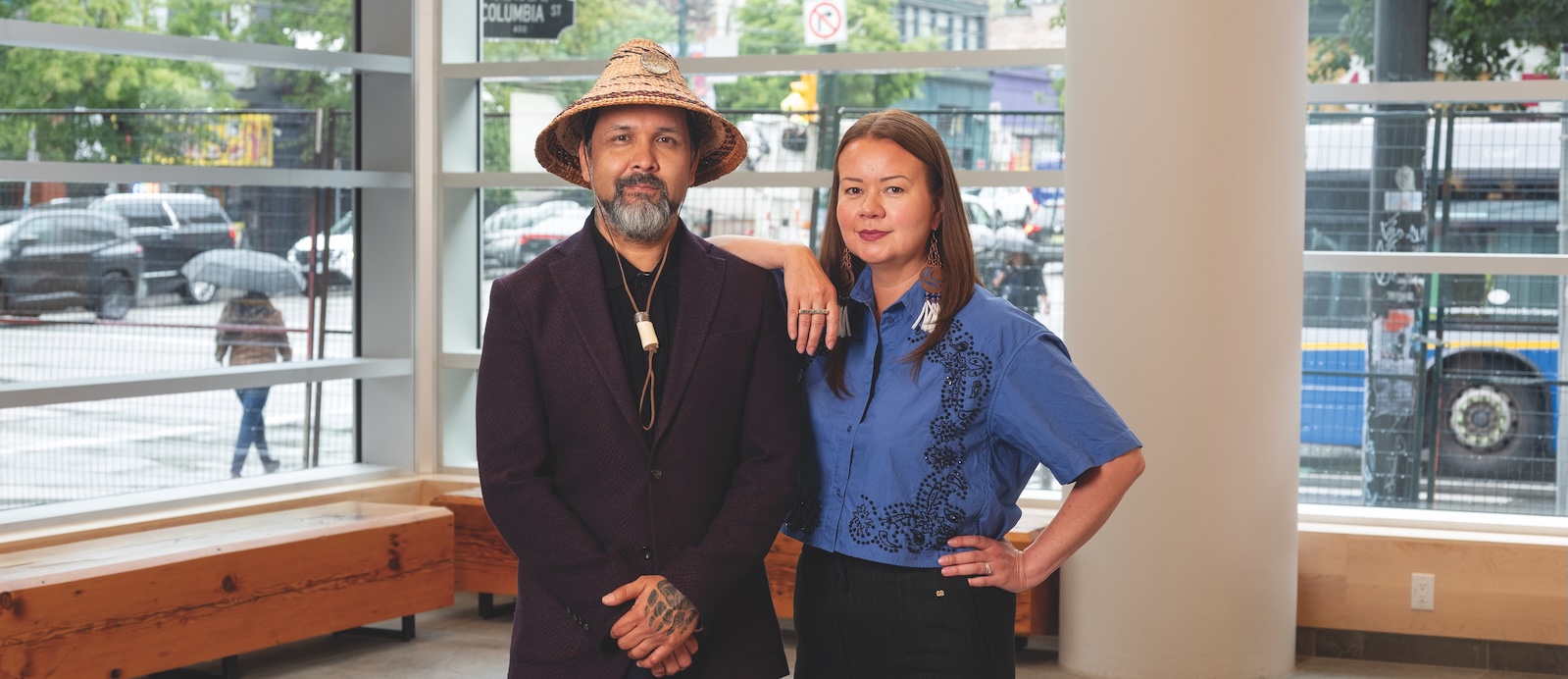
Change Can Happen. Profiles in community leadership: Ginger Gosnell-Myers & Cory Douglas
Central City Foundation is once again celebrating examples of extraordinary community leadership and innovation from the organizations we walk alongside and support. These individuals and their organizations have demonstrated that change can happen in our community. As part of this celebration, we asked each of our profiled leaders to share their thoughts on leadership, community and hope for a brighter future.
Ginger Gosnell-Myers & Cory Douglas, Indigenous Urban Planners
We are thrilled to celebrate the work being done by Ginger and Cory. Through their shared leadership in Indigenous-led planning, design and community engagement, they have consistently demonstrated the importance of embedding Indigenous history, knowledge, culture and values into the development of our communities. Their work challenges conventional approaches to city- building by ensuring Indigenous voices, histories and ways are foundational to how communities are imagined, designed and built. Through projects like the Cultural Ribbon initiative and their leadership in Central City Foundation’s Indigenous-led workshop series and Design Charrette, they have helped create meaningful spaces for learning, dialogue and co-creation. Their work continues to demonstrate what is possible when community development is grounded in relationship, cultural understanding and the principles of reconciliation.
Q: Ginger, you played an important role in Vancouver’s early shift toward reconciliation and rethinking its relationship with Indigenous peoples. How did that change begin, and how has it shaped the work you’re doing today?
Ginger: Fifteen years ago, cities weren’t really asking how Indigenous knowledge could contribute to the way we plan and build them. I was part of the Environics Urban Aboriginal Peoples Study, and Vancouver helped fund an oversample because it wanted to better understand the urban Indigenous population and their experiences.
When I presented the findings to City Council, I was originally given ten minutes and ended up speaking for about 45 because they kept wanting to hear more. Andrea Reimer, who was a Councillor at the time, has often said that presentation was the moment the light switched on for them.
I was later brought into the City as its first Indigenous Relations Manager and went on to co-create the City of Reconciliation Framework, which gave us a way to begin translating reconciliation into policies, processes and ways of working across the City.
Today, we’re actively looking for organizations and project teams willing to try something different. We’re making the case for bringing us into significant development projects, finding people willing to take a chance on an approach that isn’t yet established practice, and then using those projects to demonstrate what Indigenous knowledge can contribute to planning and design.
But I wouldn’t say we’ve normalized this work. Far from it. The roles still aren’t well defined, expectations aren’t consistent, and much still depends on particular people being willing to make space for it.
What excites me is that we’re finding people willing to take that chance. We’re moving beyond asking how Indigenous people can be included in cities we’ve already imagined and beginning to explore how Indigenous knowledge could change the way we imagine and build them.
Q: Cory, you bring both Coast Salish art and design knowledge and architectural technical experience to your work. How has that shaped the way you see our built environment, and what do you think the development and design industries have been missing?
Cory: As a Sḵwx̱wú7mesh person, one of the things I’ve struggled with is feeling invisible within the built environment of my own homelands. I came into this work with architectural technical experience, but I also had to find my way back to my own culture and eventually began practicing Coast Salish art and design. Having experience in both worlds made me realize how much knowledge the conventional design process was leaving out.
Cities have transformed Indigenous territories across Turtle Island, and planning has played a role in making Indigenous people and histories less visible. But our knowledge about land, culture, ecology and place didn’t disappear.
Planning and development are massive industries shaping our territories every day. And yet we’re still having to convince people why Indigenous expertise should be part of them. These industries are making decisions about our lands and cities, but Indigenous knowledge and expertise still aren’t understood as a normal part of the professional team.
Ginger: I encountered another side of that from inside the planning system. Planning, architecture, engineering and landscape architecture are established professions. People were accustomed to knowing who the experts were and what everyone’s role was. Indigenous knowledge disrupted some of that certainty.
I remember having a heated argument with a Senior Planner at the City of Vancouver who told me we couldn’t create Indigenous Design Guidelines because there weren’t any Coast Salish architects to make them happen. But why were we defining the possibilities so narrowly? We had Knowledge Keepers, Coast Salish artists and carvers, and people carrying deep knowledge of the land, plants and culture.
Years later, during my first WRLDCTY residency in Copenhagen, I saw a very different design culture. At BLOXHUB, they talked about bringing a sociologist onto a design team because they wanted to better understand what makes a place work for people. There was an openness to the idea that good design might require knowledge beyond the traditional design professions.
I found that incredibly validating because I had spent years asking: we don’t know everything we need to know, so who else should be part of this? That’s the kind of design culture I think we need to build here—one that makes room for different forms of expertise and is shaped by the knowledge of this place.
Q: Ginger, as organizations began recognizing the need for Indigenous expertise, what did you learn about what meaningful inclusion actually requires?
Ginger: My husband coined a term years ago that my Indigenous friends immediately understand when I use it: “The Magic Indian.” It’s what happens when an organization recognizes that Indigenous expertise is missing, hires one Indigenous person, and then expects that person to do everything Indigenous.
I experienced this at the City. I was responsible for policy, planning, research, engagement, communications, events and organizational change, while working with both the Host Nations and the urban Indigenous community. No other professional would be expected to cover that many disciplines, but because it was all considered “Indigenous,” somehow it became one job.
I don’t want to be the Magic Indian, and I don’t think any one person should be. Development and planning don’t work that way in any other area. Projects bring together architects, planners, engineers, landscape architects and other specialists because different kinds of knowledge are needed.
When Cory and I began working together seriously through Vancouver Community College, and later with Shanti Williamson, we started asking: why shouldn’t Indigenous expertise have that same kind of depth? What would it look like to build an entire ecosystem of Indigenous knowledge, professions and businesses around development and planning?
Cory: Our communities already understand that different people carry different kinds of knowledge. Our language speakers, Knowledge Keepers, carvers, singers, weavers, hunters and other cultural practitioners hold important sophisticated and respected roles. They are our professionals, valued for the knowledge, skills and responsibilities they carry.
The challenge is creating meaningful roles for that expertise within planning and development. That still isn’t normal practice. Ginger, Shanti and I are often pushing just to create those opportunities—whether that means making space for Indigenous planning expertise at the beginning of a project, or bringing a Coast Salish artist into the design process early enough to work alongside the design team and actually influence the built form.
Imagine creating architecture and public spaces that could only exist here because they emerge from the cultures, knowledge and design traditions of the Nations whose territories they are built within. We’re not there yet. We’re trying to demonstrate what becomes possible when Indigenous expertise is part of the design process itself, rather than something added to it.
And if we can build that model, it creates careers, businesses and economic opportunities for Indigenous people within an industry that is shaping our own territories.
Q: You’ve both described why Indigenous knowledge needs to be part of planning and development. But what does that actually look like in practice?
Cory: That is at the heart of what Ginger, Shanti, and I have been exploring together. Early on, we recognized that the goal wasn’t simply inserting Indigenous voices into an existing system—we had to rethink the development process from the ground up.
In a conventional model, an Indigenous artist is often invited in at the end, after the major design decisions are already set in stone. We are asking entirely different questions from day one: How can a Knowledge Keeper’s wisdom deepen our understanding of this land? How can Coast Salish design principles directly inform architectural expression and design? How might Indigenous governance and planning reshape decision-making? And crucially, who else needs to be part of that conversation?
Ginger: The challenge is turning all of that knowledge into something a project team can actually work with. How do you translate Indigenous knowledge, UNDRIP and reconciliation commitments into decisions that planners, architects, landscape architects, developers and institutions can act on?
That’s what we’ve been developing through the Cultural Contributions Framework. Rather than another set of high-level reconciliation principles, it creates a process that can carry Indigenous knowledge through the life of a project—from understanding the history and stories of a place and identifying who needs to be involved, through to concrete opportunities within planning and design.
And we don’t have all the answers ourselves. Our role is to ask: What knowledge does this project need? Who carries that knowledge? And how do we create a process that allows it to influence the work?
Cory: That is why our approach continually evolves. Every project gathers a unique constellation of people, place, and living knowledge. The Cultural Contributions Framework is not a checklist—it is responsive. What emerges depends entirely on the land beneath the project, the ancestral histories tied to it, the Knowledge Keepers who carry those stories, and the specific opportunities of the site. Change even one element, and a completely different outcome takes shape.
We are not developing a rigid formula for Indigenous design. We are building a collaborative process that allows the richness and depth of Indigenous knowledge to genuinely shape what each project becomes.
Ginger: And that can change how people understand the place itself. So much Indigenous history has been erased from our cities that people can live somewhere their entire lives without knowing the original name of the place or why that land was important.
Imagine knowing the Indigenous name of the place where you live, understanding the stories connected to that land, and seeing those histories reflected in the places around you—not as something people are expected to feel guilty about, but as knowledge everyone can share in and celebrate.
It becomes a way of restoring the story of place.
Q: Through your work with Central City Foundation, you had an opportunity to apply this approach to the Abbott Mansion. What happened when CCF gave you the space to try something different?
Cory: Through this meaningful engagement, we uncovered a much deeper history of the land. While most people know the site through the Abbott Mansion, Sḵwx̱wú7mesh oral history names it Luk’Luk’I—“grove of beautiful trees.” We began to understand this place through a far longer lens; its story did not begin with the building that stands there today.
Working closely with Jennifer Johnstone at CCF and Derek Lee at PWL Partnership, we created a process that brought Knowledge Keepers, community and a variety of Indigenous expertise into the early thinking for the project, ultimately bringing that knowledge together through an Indigenous-led design charrette.
The conversation quickly moved beyond mere aesthetics. Instead of simply asking what an Indigenous building should look like, we examined what Indigenous women-centered housing truly requires: spaces for intergenerational living, rooms for ceremony and healing, an architecture of belonging, and built-in pathways for Indigenous leadership and economic sovereignty.
CCF gave us the space to demonstrate what becomes possible when the answers aren’t predetermined.
Q: Looking ahead, what still needs to happen—and what do you hope comes next?
Ginger: If we want this work to become normal rather than something that depends on a few willing organizations or individuals, the systems around it have to change too.
We need clearer policy around Indigenous involvement in planning and development, and incentives that give developers a reason to invest in doing this work well. We also need clearer relationships between Indigenous professionals working within municipalities and First Nations, and those of us working with developers and project teams. Those roles should be complementary rather than competitive.
The next challenge is building the policies, incentives and relationships that allow this to become part of how development and planning are done—not something exceptional that depends on a handful of people or projects.
Cory: The next step forward is meaningful collaboration—bringing Indigenous design professionals directly alongside industry teams to shape the future of our territories. Our goal is for xʷməθkʷəy̓əm, Sḵwx̱wú7mesh, and səlilwətaɬ communities to be more than just represented in the built environment; we want to be actively co-designing it.
Achieving this requires expanding professional opportunities, backing Indigenous enterprises, and modernizing procurement to recognize cultural expertise alongside conventional practice. When we do this, K’emk’emeláy̓ (Vancouver) will truly reflect a modern Coast Salish city of thexʷməθkʷəy̓əm, Sḵwx̱wú7mesh, and səlilwətaɬ, shaped in genuine partnership.
As Chief Ian Campbell has reminded us, the future isn’t about creating a divide between “us” and “them.” It’s about building that future together.
Ginger: We don’t inherit better cities. We create better ways of building them.
 Previous story
