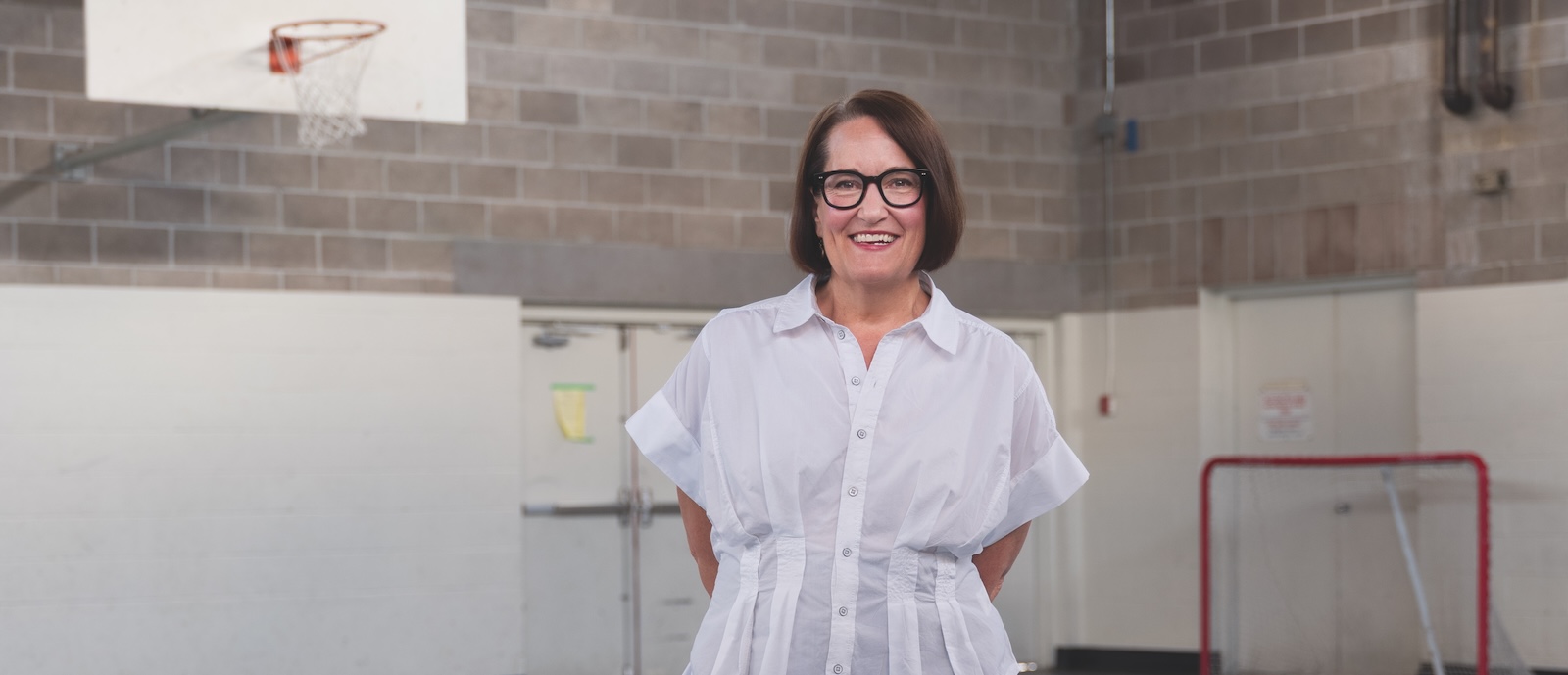
Change Can Happen. Profiles in community leadership: Carolyn Tuckwell
Central City Foundation is once again celebrating examples of extraordinary community leadership and innovation from the organizations we walk alongside and support. These individuals and their organizations have demonstrated that change can happen in our community. As part of this celebration, we asked each of our profiled leaders to share their thoughts on leadership, community and hope for a brighter future.
Carolyn Tuckwell, President & CEO, BGC South Coast BC
As President & CEO of BGC South Coast BC for more than 20 years, Carolyn has helped make a difference in the lives of countless children, youth and families. Time and again, her work has shown the importance of creating safe, inclusive spaces where young people can develop relationships, build their life skills and feel connection and a sense of belonging. Through her leadership, BGC South Coast BC continues to evolve and ensures young people facing barriers have access to support, mentorship and community when they need it most. Carolyn’s leadership has also helped advance innovative, youth-centred approaches and advocacy that recognize the importance of accessible, no-barrier programs.
Q: If you could describe a vision for the future of our community and the people who live and work here, what would that vision look like?
What I see is a community where every child grows up with the essential supports, resources, and conditions they need to thrive. Foundational to that is building a culture of genuine appreciation and choosing curiosity over judgment during challenging moments to better understand one another’s experiences. Ultimately, we thrive when those who live and work here actively focus on what we have in common rather than on our differences.
Q: How would you describe some of the common lived experiences, systemic inequalities/inequities and other challenges faced by the people you work with? Do you have any examples that might help explain to folks who aren’t familiar with these experiences how these challenges impact the lives of the people you serve/work with?
The lived experiences of children and youth (and their families) in BGC’s programs include being new Canadians, Indigenous peoples, single-parent families, having financial struggles, and speaking a language other than English as their first language – essentially the people reflected in the category of “equity deserving groups”. Those factors and/or experiences are often associated with being judged based on stereotypes and experiencing systemic barriers to accessing necessary and even equitable supports and services for themselves and their families. Meanwhile, what we consistently witness through our relationships with families is that they are always trying their best and fully committed to providing their children with the best possible life they can, hoping for them to thrive and grow up to be happy, healthy adults. I think it’s easy for us to overlook the reality that whether we realize it or not, people usually know when they are being judged with social stereotypes, and silently carry that as a heavy, silent burden through their lives. These realities have significantly influenced how we at BGC think and talk about those we are here for with dignity, respect and hope. Rather than following the usual formula of defining those who participate in our services as in need, we focus on the potential in every one of us, and the things (based on evidence around human development) every human needs to thrive. Imagine enrolling your child or participating yourself in a program you’re excited about, and then reading in the marketing materials that the people the program serves are “at risk”, underprivileged, struggling. Drawing us together around the reality that at any point, any one of us could need/want/choose help, and the promise of living in a supportive community is what we hope people will be inspired by.
Q: How does your organization / your work help address some of the challenges faced by people in inner city communities? What barriers or opportunities are you attempting to address or create? Are there particular policy changes or other actions that your organization is undertaking to address the systemic inequities you’ve described?
There are 2 key ways that BGC is addressing challenges faced by people in our communities.
Public Policy Change: Recreational Care within BC’s Child Care Licensing Regulations; in 2018/19, serious incidents in child care settings prompted the BC Government to require any programs/services resembling child care to be licensed within Child Care Licensing Regulations. This included BGC South Coast BC’s Club programs. Within BGC South Coast BC, that would have reduced the number of children and youth served through our Clubs from approximately 3,000 to less than 300. As we believe in and support all efforts for standards and quality for programs providing child care and related programs for children, BGC South Coast BC sought to work directly with the Ministry of Health (which oversaw Child Care at that time) to begin discussions regarding a pathway to preserve the programs and services BGC South Coast BC offers based on the BGC’s evidence/track record offering high quality programs with a strong safety record. That strategic work resulted in the introduction of the Recreational Care category in Child Care Licensing. To date, BGC remains the sole provider of this model of child care in the province. This policy change has not just preserved the existing programs BGC is offering but lays the path for us to continue to expand our high impact work into new neighbourhoods across the South Coast of BC, providing equitable access for all families who wish for their children to have a safe, supportive, enriching place to belong when they aren’t at home or at school.
It’s important to note that increasingly, nearly all neighbourhoods are mixed. It might be worth noting that, even historically, that was true, but people in predominantly “wealthy” neighbourhoods who were living in poverty were hidden/unseen. While that continues, “inner city” neighbourhoods are experiencing development that is forcing people and families out of places they could previously afford. In each of our locations, BGC’s goal is to be a place where parents – regardless of their financial capacity – know that their children and youth are welcome, safe, and have great opportunities for their out-of-school hours, and that there are no financial barriers to participating. Over time, BGC has also learned that “free programs” are often overlooked, considered to be low quality, and/or “for someone who needs it more than me/us”. We also consistently find that parents want to contribute something (even if it’s a small amount) to programs that they value. By removing financial barriers, committing to organizational practices rooted in cultural sensitivity and using evidence-based practices in everything we do, we are levelling access and helping children and youth to build lifelong friends and develop skills for life through incredible opportunities and experiences.
Q: How would you describe the importance of community connections and a sense of acceptance and belonging for the people you work with?
Belonging and acceptance are foundational to everything we do at BGC. Our core belief that EVERY KID IS AMAZING not only guides our work, attention and focus, but is intended to be the key message and experience for every child and youth who becomes a member. There’s no “might be, could be, would be if only…”. Each individual is unique, and we’re here to be alongside them (and their family) to offer a safe, supportive environment and opportunities for each of them based on who they are, their needs, and their aspirations. Acceptance and belonging ARE what BGC is all about.
Q: Looking ahead, can you share with us some of your thoughts about where you see possibilities for change to happen?
BGC South Coast BC has built evidence-based approaches into all of our programming that support rigour in a highly flexible and adaptable model, sound outcome measurement, and our role as an employer in order to fully deliver on our Vision, Mission, Values and Purpose. We do our work in a cost-effective and financially responsible way. The non-profit/charitable business model is challenging, often being held to unrealistic standard/expectations (do/serve more with less, operate without overhead or administrative costs). By doing the very difficult work of building an approach that quantitatively and qualitatively proves the impact of our work, we are able to confidently report the concrete human outcomes of our work as we seek to attract more investment to support our goal of reaching every neighbourhood where kids and youth are unsupervised.
Q: Do you have any stories or examples from your work that particularly give you hope for a better future for the people you work with?
We have countless stories of success from our programs that reflect what evidence tells us: that frequency, intensity and duration of involvement with BGC increase the impact and protective factors in children’s/youth’s lives. We believe the most impactful way of reflecting that is in our Learning and Impact Report (attached). We can certainly illustrate in stories, but we have learned (and continue to experience) that it is providing this clear, quantitative and qualitative evidence that helps people to believe that this work has enduring impact.
Q: How would you describe the value of developing relationships and collaboration in your work generally and with organizations like Central City Foundation?
Our own work to refocus and commit to our Vision, Mission, Values and Purpose has helped to fine-tune the focus of our work, priorities and goals. Staying clear on what we exist to do has helped to emphasize the importance of building the required relationships to help drive us towards the outcomes we seek, and to collaborate to expand/enhance and/or amplify our impact through collaborations with organizations and groups who have skills, access or resources that can complement ours. Relationships and collaboration are successful when each party is clear on what their contribution/role is. From there, amazing things happen!
Q: What has support and/or partnership from Central City Foundation meant for your organization or your work?
Over the years, Central City Foundation has been an incredible partner/funder of 5 key projects – 4 kitchen renovations and one lounge furniture replacement. Without CCF, BGC would not have been able to make these important facility-based improvements that play a role in making our spaces warm, welcoming and inviting. Their willingness to invest in critically needed upgrades and equipment for our Clubs has been incredible. What we have appreciated most is Central City’s understanding of how projects/equipment are essential to our ability to offer our programs: healthy, nutritious food fuels our participants AND engages them in learning about food preparation and increases the likelihood of them trying new things, while comfortable, safe places to rest, read, and hang out with their peers encourage social engagement and relationship building. These investments directly contribute to BGC’s impact. Beyond the financial support, BGC is so appreciative of the Central City Foundation’s voice and advocacy for our sector and the community. That they continue to commit to building, supporting and advocating for community-led solutions brings credibility and profile to our sector that is invaluable. That drives authentic and enduring positive change for all of us.
Q: Can you share a call to action for our CCF community?
CHOOSE to invest in our community through a non-profit/charity that addresses a need/cause or issue they care deeply about. If that could be a call to support BGC South Coast BC, here it is: Grow, increase, strengthen, expand, develop, maximize, cultivate – whatever you call it, what we know is the world needs MORE BGC. And BGC needs YOU!
Right now, everything in the world feels like it’s followed by a thousand exclamation points. We all see it and feel it, and the truth is that kids see and feel it too. And while we hope that every kid has a childhood that is joyful and fun, we know that childhood can also be hard. Kids worry about what’s going on in the world. They worry that they won’t measure up. When the loudest voices around them are angry and hateful, kids notice. Sometimes, when kids hear those loud, angry voices, they try it out themselves. Not because they are hateful, but because they are learning. The good news is, we know that kids WANT to be amazing! They want to have friends, and they want to get it “right.” When they have someone to come alongside them, be there to listen, guide, let them fail and believe in them still, and give them a place where they can come every day even when they make mistakes, it brings out all their amazingness.
Enter BGC’s Strategic Plan, which clearly focuses on our biggest goal: bring the world MORE BGC. Get MORE kids into MORE clubs for MORE of their childhoods, because that means even more human impact right here in our communities. We can’t do it without you.
BGC South Coast BC’s prevention programs (i.e. Clubs and Camp) are self-funded, and families pay what they can. For a lot of families, that means they only pay a little or nothing at all. That’s important because it means that no kid is left behind. We fundraise for the rest (which is A LOT). So, when you give to BGC, you are helping provide spaces where kids and youth can be themselves, experience new opportunities to help them explore their interests and hobbies, make friends, and get support from adults who want the best for them. In short, your gift gives kids and youth the opportunity to discover and be their AMAZING selves!
 Previous story
